Unpaid leave: one approved request moves the pay, the cap and the balance

An unpaid day for someone on €1,200 a month costs €57.61. Three of them in March take €172.83 off March's pay.
In most companies that number gets rebuilt by hand. The absence is approved in one place, and at the end of the month somebody opens a spreadsheet, counts the working days, divides a salary by something, and edits the payslip. The arithmetic is easy. Remembering to do it, twelve times a year, for everyone who took a day, is not.
Teamtopia does it on approval. One request moves the month's pay, the yearly cap and the PTO balance, from rules the office sets once.
What an approved unpaid day does
- The month's salary drops by the cost of the working days actually missed.
- PTO stops accruing for those days, on the balance the employee reads.
- The days count against that office's yearly cap, with what's left shown to the employee.
- The absence appears on the team calendar, syncs to Google and shared calendars, and posts to Slack.
- Nothing is drawn down: unpaid leave has no balance, so the request form has no counter.
A day costs the same in February as in March
The obvious way to price an unpaid day is to divide the salary by the working days of the month it falls in. It is also the wrong way. February might hold 20 working days and March 22, so the identical absence would cost more in February, for a reason no employee should have to accept.
Teamtopia prices a day against the working year. Take the year's days, subtract the days the office doesn't work and the office's holidays, and divide by twelve:
365 days − 104 weekend days − 11 holidays = 250 working days.250 ÷ 12 = 20.83 working days in an average month.€1,200 ÷ 20.83 = €57.61 a day.
The holidays counted are the office's, never the individual's, so one person's holiday swap can't move their pay relative to a colleague's.
What actually gets charged
Working days, and only the ones inside the month. A Friday-to-Tuesday absence costs three working days, not five — even in an office that records leave in calendar days. An absence running 26 February to 3 March is split: February pays for its part, March for its own.
Open Payments and the month is already reconciled. The salary cell still shows the contract figure; Unpaid salary, the column total and the sidebar summary carry the deduction, with a tooltip next to the number that changed:
"2 unpaid leave days deducted, at €57.61 a working day."
The monthly figure is rounded to whole money, so the amount the pay field offers is the amount that closes the month.
What the employee sees
Filing a request is two dates, a calendar and an optional reason. Before they file, the same rules the office set are waiting on their own leave-policy page, in plain sentences:
- "A single request can cover up to 5 days in a row."
- "You can take up to 10 unpaid days per year — 4 left this year."
- "Each unpaid day reduces that month's pay by the cost of one working day."
- "Vacation days do not accrue while you are on unpaid leave."
- "A manager has to approve each request before it takes effect."
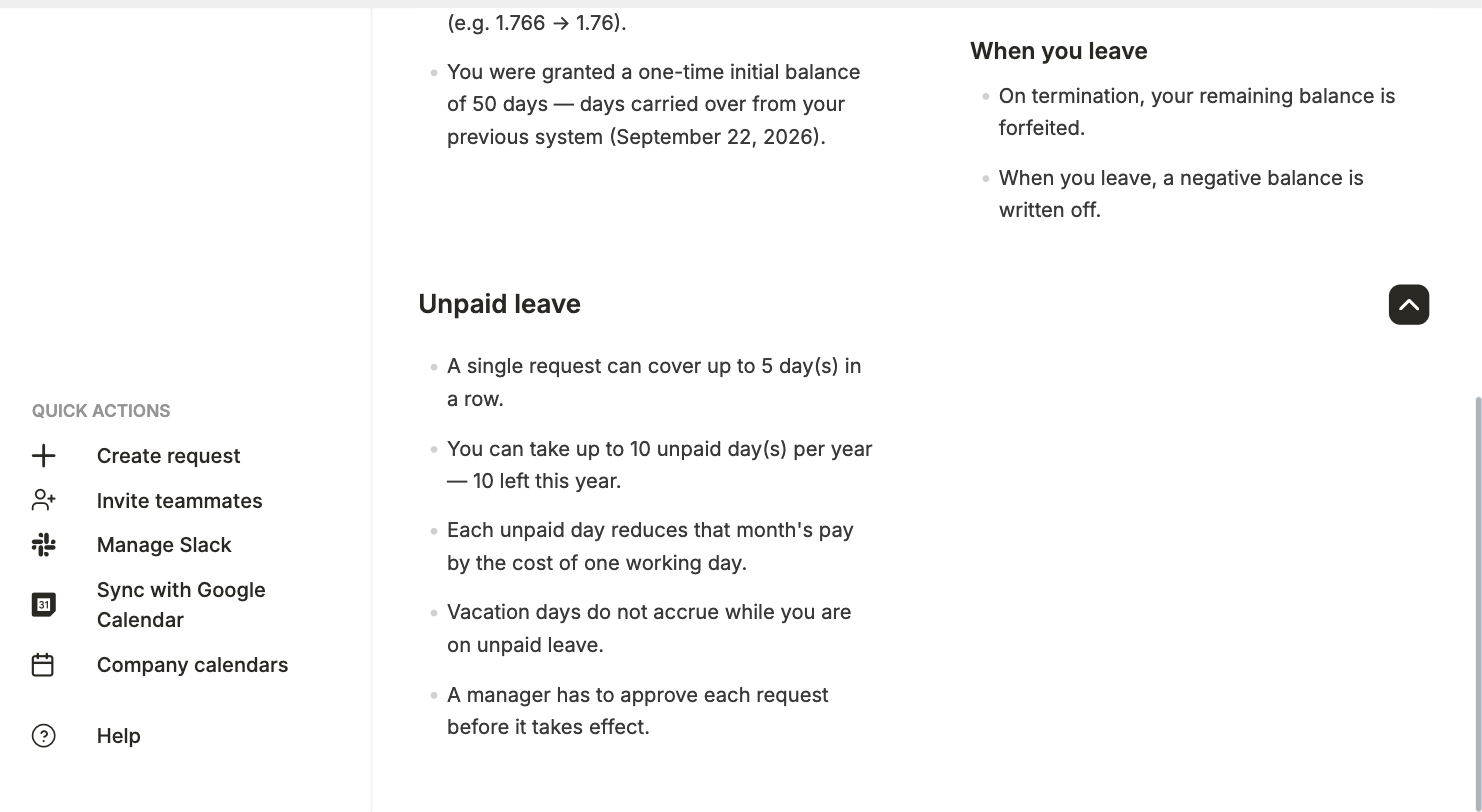
The days-remaining figure is counted the same way the cap counts, and the pay and accrual sentences read the same settings payroll reads. What the employee is told is what happens.
Notice the pay sentence carries no amount. Employees see the shape of the cost, never a personal figure — salary numbers stay behind salary permissions.
The rules each office sets
Offices run on different laws and different holiday calendars, so the rules belong to the office, not the company:
- Minimum service — how long someone has to be with the company before they can ask.
- Maximum consecutive days — how long a single absence can run.
- Annual limit — how many unpaid days a calendar year allows. Pending requests reserve their days, so the cap can't be beaten by filing twice.
- Deduct from payroll — whether unpaid days reduce that month's salary.
- Pause PTO accruals — whether time off keeps accruing while someone is away unpaid.
- Manager approval — whether a request has to wait for approval before it takes effect.
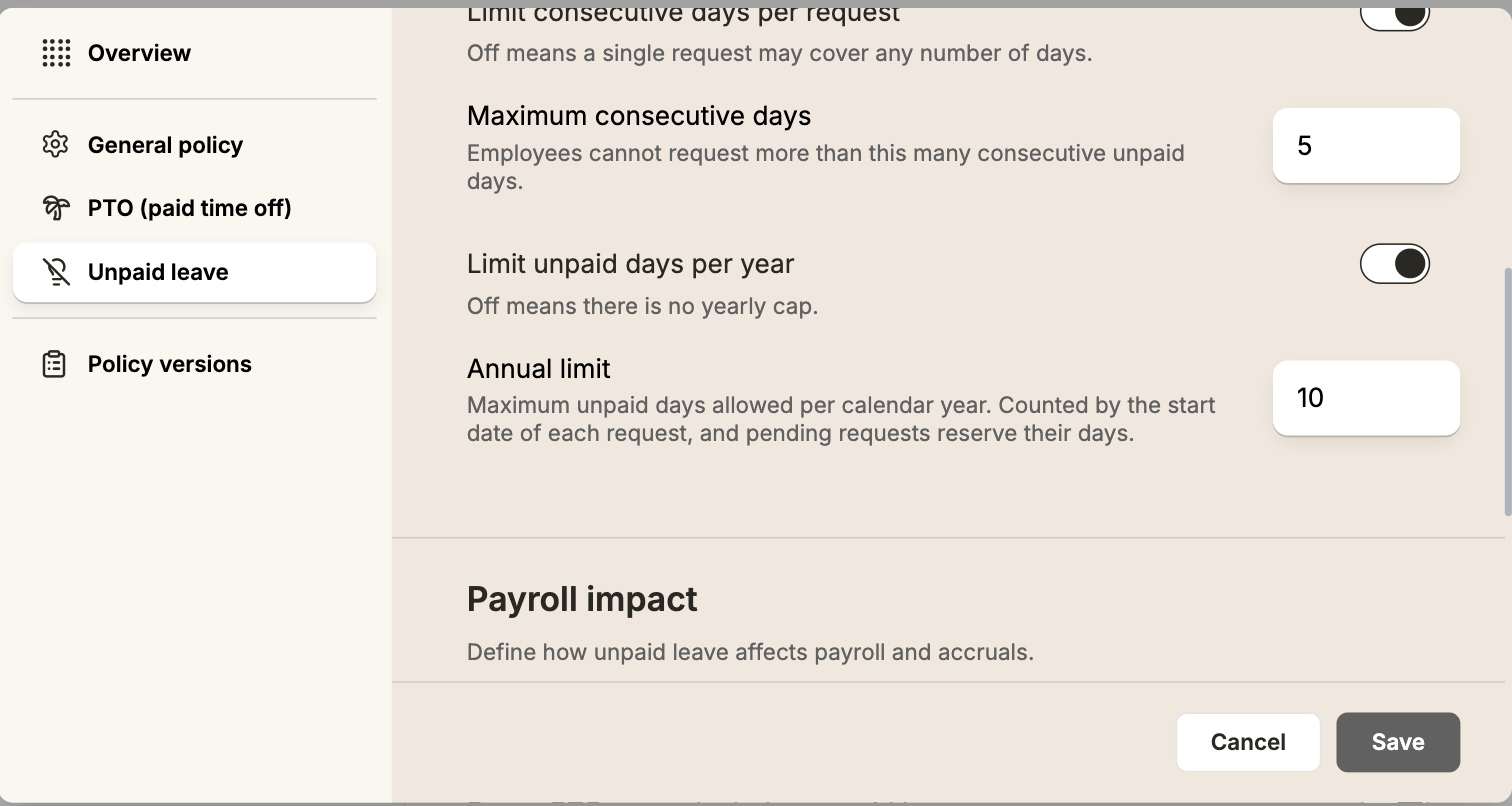
Rules that refuse are better than rules that warn: a request over a limit can't be saved, and the employee reads which limit stopped it, right under the calendar. A limit that only flags is a limit you discover at payroll. Owners can always override.
Change a policy in June and the June rules apply from June. Requests already approved under March's rules keep them.
Turning it on
Open the office you want, go to HR policy, and pick the Unpaid leave tab. Set the limits you need — or leave them all off — and save. The rules apply to requests from that day, and the employee's policy page starts describing them the same morning.
Already using day off? It's the same section under a new name — deduction and the accrual pause work from the start.
Authors
FAQ
Yes, by default. Each approved unpaid day takes the cost of one working day off that month's salary, and the change appears as "Unpaid salary" on the Payments page, with a tooltip giving the number of days and the day rate. The "Deduct unpaid leave from payroll" switch is on by default and can be turned off for each office.
From the working year, not from the month. Teamtopia takes the year's days, subtracts the days the office does not work and the office holidays that fall on a working day, then divides by twelve. A day therefore costs the same in a short February as in a long March. Only the office's working days inside the leave are charged, and a leave that crosses a month boundary is split between the two months.
No, not by default. "Pause PTO accruals during unpaid leave" is on by default, and the pause reaches the balance shown on the employee's profile, not only the ledger underneath it. Sick leave has no accrual in Teamtopia, so nothing there is affected.
Yes, with two independent caps, both off until you turn them on: the maximum consecutive days in a single request, and an annual limit per calendar year. The annual count runs from 1 January, and requests still awaiting approval already reserve their days. If both caps are set, the annual limit must be at least the maximum consecutive days.
It is the same section, renamed. Every absence recorded as a day off stays exactly where it is and now appears as unpaid leave. What changed is that the section carries real settings instead of being only an on/off switch.
In one edge case it comes close: a full month of unpaid leave is priced at roughly 20.83 days, while a given month may hold 22 working days. The deduction floors at zero, so a salary never goes negative.
No — unpaid leave is counted in whole days. It also follows the day-counting mode the office already uses for leave, rather than carrying a separate working-versus-calendar-days setting of its own.